lOS ANGELES HOUSING CRISIS: SOURCE AND SOLUTION
Decentralized Density, Technology for Agency, and Governance through Self-Determination
Suggested Citation
Alvarez, Dario. Los Angeles Housing Crisis: Source and Solution. Los Angeles: Center for Pacific Urbanism, 2026.
City of Los Angeles Housing Stock by Building Type and Age.
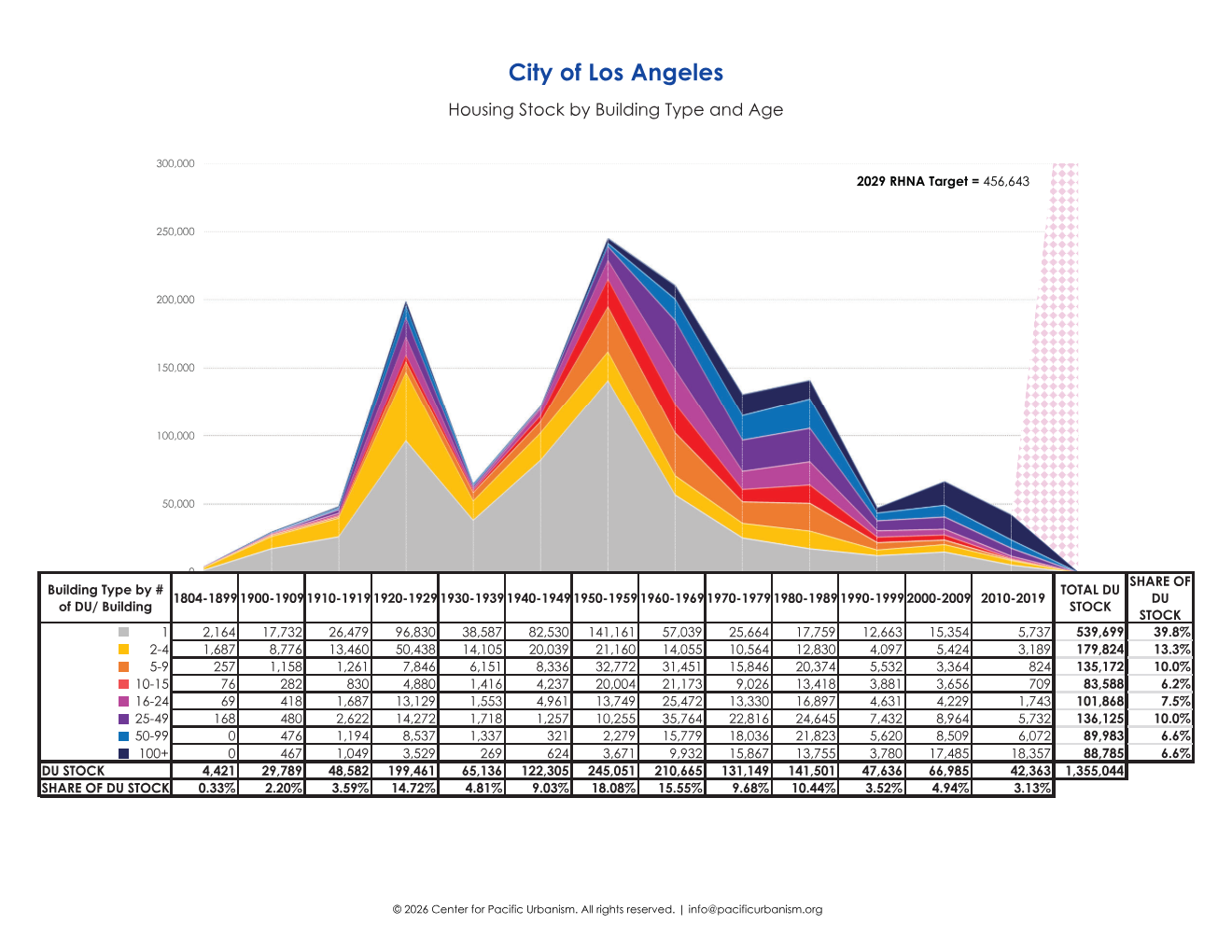
Figure 1. City of Los Angeles Housing Stock by Building Type and Age.
Source: Center for Pacific Urbanism, Housing Stock Analysis, March 10, 2025.
ABSTRACT
Los Angeles has a housing shortage, but it does not lack the land, building types, technology, capital, or people necessary to produce the housing it needs. The principal constraints are Zoning regulations that determine how many dwelling units may legally be built. The City of Los Angeles needs approximately 60,000 new dwelling units per year to meet its approximately 450,000-unit housing need within eight years. The existing housing stock demonstrates that nearly half of its housing was produced in buildings containing two to 49 dwelling units per building, while less than 7 percent was produced in buildings containing 100 or more units per building. This paper proposes restoring housing-production capacity through decentralized density, in which sufficient base density is equitably distributed among communities according to measurable conditions and housing is produced simultaneously across a broad range of properties, building types, and builders. It pairs this approach with technology in support of community agency, through which communities translate quantified housing obligations into densities, building types, and physical plans, and governance through self-determination, through which the opportunity to produce, own, control, and benefit from housing is distributed among a broader range of people. Together, these propositions provide a practical framework for contributing to a solution to the housing shortage while expanding participation in the planning, production, ownership, and economic benefits of residential infrastructure.
The rate of housing supply in the City of Los Angeles needs to increase approximately five times, from the current rate of about 12,000 new dwelling units per year to about 60,000 new dwelling units per year over eight years, in order to meet its need of approximately 450,000 net new dwelling units.[i] This increase in supply can be accomplished through reasonable and practical policy changes that address the root causes of constraints on the housing supply. This paper challenges the conventional wisdom regarding the intractability of the housing shortage’s root causes and proposes practical, implementable solutions for local communities to supply, maintain, and reap the benefits of housing in their neighborhoods.[ii] Generally speaking, zoning caused the crisis and zoning will cure the crisis.
This paper advances three main ideas: 1) that specific and quantifiable densities of housing need to be equitably distributed among all communities so that a fair share of the supply can be produced in areas where housing is best suited according to empirical metrics; this geographic distribution of housing leads to a form of urban development that we refer to as decentralized density. 2) The most suitable application of technology is that which maximizes agency for individuals and communities to participate in the planning and production of housing, rather than that which seeks to reduce or remove the role of communities in civic, industrial, and economic participation. 3) Housing policy, buildings, and residential communities need to reflect self-determination through homeownership and landownership, rather than paternalistic forms of subjugation and control.
Introduction. How we got here and what to do about it.
Current land use policies throughout the City of Los Angeles have limited the number of dwelling units that may be built in each community. As a result, housing supply rates in the City of Los Angeles have declined from an apex of approximately 20,000 new dwelling units per year to a current low of about 12,000 new dwelling units per year.[iii] In the face of an increasing population, the demand for housing, coupled with decreasing rates of supply, results in rising housing prices. Increases in housing price continually exacerbate housing precarity, vehicle miles traveled, particulate matter in the air, polluted stormwater runoff, greenhouse gas emissions, increased cost of labor, and reductions in regional economic productivity, among other adverse social, environmental, and economic impacts.
The root cause, among a variety of factors that influence the constrained rate of local housing supply (i.e. the cost and availability of labor, materials, and land), is the allowable number of dwelling units per unit area of land, sometimes referred to as base density. [iv] The significance of base density as a collection of land use policies, related regulations, and processes that govern the allowable number of dwellings that may be built on any given unit area of land is that the number represents what homebuilders in the supply market may be permitted to do “by right”[v] and through ministerial approval; that is, upon certification that the proposed project conforms to applicable regulations and collection of the applicable fees, a permit may be issued for its construction. In other words, base density establishes how many homes are allowed to be built on any given parcel. However, over the last approximately 60 years, allowable base density in the City of Los Angeles has been reduced to less than half of its previously allowed total number of dwelling units.[vi] The City has adopted a housing policy that reduces and restricts allowable density in most places while providing additional development capacity through density bonuses and other incentive programs, generally in exchange for deed-restricted affordable housing. These policies are commonly described as forms of inclusionary zoning, even though the underlying regulatory structure begins by restricting the amount of housing that may otherwise be built. In contrast to by-right and ministerial approvals, many housing projects require entitlements through discretionary approval. The effects of the existing approach include the reduction of the absolute number of dwelling units offloaded onto the housing market each year and increased domination of supply by fewer and fewer for-profit and non-profit housing developers, particularly in building types with greater and greater numbers of dwelling units in individual projects.
Over the past five decades, restrictions on base density in the City of Los Angeles have been codified in a variety of ways, including through the Community Plans, by redefinition and reduction of the allowed intensity of residential land uses, redesignation to more restrictive land use classifications, limits on the allowable size of buildings, and parking requirements within a finite building envelope, among others. [vii] For a variety of reasons that have been explored elsewhere, entitlement procedures that purport to allow density bonuses in designated areas in exchange for the inclusion of affordable housing have not resulted in the production of housing in numbers sufficient to meet the demand for housing.[viii]
Historically, approximately half of all housing in the City of Los Angeles has been supplied through small and medium buildings, that is, those with two to 49 units in them. During the decade of the 1960s, a period of substantial housing production in the City, almost two-thirds (59%) of all housing was supplied in buildings in the 2- to 49-unit categories. From the 1970s onward, as a result of restrictive land use policies, the overall supply number has continued to diminish, while the share of the supply has continued to be dominated by the category of buildings with more than 100 units in them. The result today is a homebuilding industry that is largely dominated by fewer, larger, both nonprofit and for-profit developers whose approach toward homebuilding tends toward centralization of housing production in fewer but larger buildings and often segmented according to household income.[ix] When residential development capacity requires increasingly complex, costly, or conditional processes, projects and producers capable of absorbing those costs gain a relative advantage; restoring “by-right” base density lowers that threshold and allows small, medium, and large producers to operate simultaneously.
Although the largest buildings have historically provided fewer dwelling units in absolute numbers than their smaller counterparts, land use policies today favor the larger building types and those developers who supply them. In this sense, public policies are picking winners and losers, yet the housing shortage remains unresolved. The centralized approach toward housing, despite the intent of inclusivity and limited by the discretionary approval of entitlements, has historically produced fewer total dwelling units than the decentralized, ministerially approved, by-right approach to the supply of housing.[x]
In round numbers, 60,000 new dwelling units offloaded onto the housing market per year for a period of eight years would meet the City’s approximately 450,000-unit housing need. Today, only about 12,000 new dwelling units per year are offloaded onto the housing market. Buildings containing between two and 49 units have supplied close to half of the City’s existing housing stock, whereas the largest building types, buildings containing 100 or more dwelling units, have supplied less than 7 percent.[xi]
Decentralized Density
Decentralized density, equitably distributed to allow reasonably expected development of housing in numbers sufficient for each community to meet the regional needs, expands both the amount of housing that can be produced and the number of people capable of producing it. To realistically meet the housing need, approximately 60,000 dwelling units per year need to be distributed among communities throughout the City and produced simultaneously through buildings of different types and sizes. For example, a four-unit building may be produced by a property owner or small builder, a twenty-unit building by a local developer, and a two-hundred-unit building by an organization with access to substantially greater capital and expertise. These forms of housing production can occur at the same time. Increasing base density throughout the City increases not only the number of dwelling units that may legally be built, but also the number of properties upon which housing may be built and the number of people with the practical and financial capacity to participate in its production.[xii]
Geographic distribution and the Housing Allocation Index (HAI)
In 2019, the Center for Pacific Urbanism developed the Housing Allocation Index (HAI) as a formula-based method for distributing the City’s housing need among its 35 Community Plan Areas according to measurable conditions within each community. The HAI uses empirical data measuring affordability, environmental health, transit quality, historical downzoning, and access to opportunity. For each measure, the Community Plan Areas are assigned percentile scores according to their relative conditions, and those percentile scores are combined to produce a composite index score for each community. Each community’s composite score is then calculated as a percentage of the sum of the composite scores for all 35 Community Plan Areas. The City’s housing target is distributed according to those percentages, so that each community receives the same percentage share of the City’s housing target as its share of the total HAI.[xiii]
The HAI provides a basis for reforming the Community Plan process by establishing a quantifiable housing objective for each Community Plan Area based upon empirical conditions rather than beginning with the existing distribution of allowable density and determining incrementally where additional housing might be accommodated. The original HAI demonstrated this method by distributing the City’s then 463,682-unit Regional Housing Needs Assessment (RHNA)[xiv] target among the 35 Community Plan Areas and calculating both the total and annual housing target for each community.[xv]
Starting from the equitable distribution of housing targets under the HAI, a community may choose to plan for less or more than its allocated share of the housing target, producing a so-called balloon effect in planned allocation. Because the citywide housing target remains constant, any reduction in one community’s planned housing capacity must be offset by a corresponding increase in capacity elsewhere. Where one community constricts its allowable supply, therefore, other communities must expand their allowable supply in order for the City as a whole to maintain sufficient capacity to accommodate the total housing target.
Technology in Support of Community Agency
In the context of contributing to the solution to the housing shortage, the most appropriate application of technology is that which increases the agency of individuals and communities to participate directly in the planning of their communities. The Community Plan process needs to provide for the translation of housing targets into allowable densities, land use designations, building types, and ultimately, a visualization of the built environment that could result from such Plans. The Los Angeles Advancing Community Centered Outcomes in Regional Development (LA ACCORD) provides a participatory community planning tool through which community members participate directly in making these decisions. The LA ACCORD applies the housing allocation established by the HAI to land use planning within each Community Plan Area. Whereas the HAI determines how much housing allocation equitably corresponds to each community, the LA ACCORD allows community members to determine where that housing is distributed within their community by building type. The LA ACCORD organizes the Community Plan Area into swaths of land according to land use designation and identifies the existing number of dwelling units and housing target within each area. The sum of the existing dwelling units plus the community driven housing target is translated into a new density in dwelling units per acre and then into recognizable building types, allowing community members to select the building types they consider desirable or acceptable in different areas of their community. The resulting Land Use Plan maintains a quantifiable relationship between the City’s housing need, the housing allocated to each community, the density assigned to each land use designation, the building types selected by the community, and the resulting built environment. Most importantly, the LA ACCORD provides for broad, substantive public participation in the Community Planning process.[xvi]
Governance through Self-Determination
The production of housing results not only in new dwelling units but in the ownership of land, buildings, and other assets that have economic value. Under the conventional for-profit rental housing model, the renter pays a property owner for the use of a dwelling while the property owner retains ownership, receives the income generated by the property, and benefits from its appreciation over time. Under the non-profit rental housing model, the ownership and disposition of profits are different, but the relationship of the renter to the property is substantially the same. The renter pays for the use of a dwelling owned by another entity and does not acquire an ownership interest in the land or building through the payment of rent.
By contrast, homeownership allows the resident or community to acquire an ownership interest in the housing that they consume. Increases in the value of the property accrue to the individual or collective owner, and the resulting asset may be sold, borrowed against, or transferred to subsequent generations.[xvii] Where land use policies allow additional dwelling units to be built on the property, the homeowner may also participate in the production of housing. A homeowner who adds one, two, or several dwelling units becomes both a consumer and producer of housing and may receive income from the housing that they produce.
At the community scale, when housing production is concentrated among a relatively small number of large for-profit and nonprofit organizations, ownership of the resulting housing and much of the economic benefit associated with its production are similarly concentrated. If housing production is distributed among thousands of properties, then the opportunity to invest in housing, own income-producing property, and to benefit from positive community economic spillover effects is also distributed among a greater number of people.
In this sense, the question of who produces housing is related to the question of who benefits from its production and who retains control over the conditions under which residents may remain in the housing. A housing policy that seeks to increase the number of dwelling units without considering who owns the resulting housing may fail to address who stands to benefit from the assets created through housing production. Affordable housing that conditions a resident’s eligibility upon remaining within prescribed income limits creates a relationship in which continued access to housing is tied to continued economic qualification, such that an increase in household income may result in the loss of eligibility for the housing itself. The resident therefore remains subject to conditions established and administered by the entity that owns the property, rather than acquiring greater control over the housing as the household’s economic circumstances improve. A policy of decentralized density expands the number of people capable of producing housing; a land use policy that expands opportunities for homeownership, landownership, and participation in production expands the number of people capable of owning, controlling, and benefiting from what is produced.
Conclusion
The City of Los Angeles’s approximately 450,000-unit housing target over the eight-year RHNA cycle represents an annualized housing-production rate of approximately 60,000 new dwelling units per year. The City’s existing housing stock demonstrates that Los Angeles has historically produced housing at greater rates through a decentralized range of building types and sizes, with nearly half of its existing housing stock produced in buildings containing two to 49 dwelling units, while buildings containing 100 or more dwelling units account for less than 7 percent. Restoring a higher base density throughout the City enables this decentralized model of housing production by expanding the number of dwelling units that may legally be built, the number of properties upon which housing may be produced, the range of building types through which it may be produced, and the number of people with the practical and financial capacity to participate in its production.[xviii]
This increase in housing capacity should be equitably distributed among the City’s communities and residents according to measurable conditions, including housing affordability and demand, environmental health, access to transit and employment, historical reductions in housing capacity, and access to opportunity. Each community will need to accommodate a quantifiable share of the City’s housing target and will determine how that housing is distributed within the community. Technology in support of community agency provides residents and stakeholders with the information necessary to translate housing targets into allowable densities and recognizable building types while participating directly in determining the physical form and distribution of housing within their communities.
The supply of housing produces land and buildings with economic value, income, employment, professional work, businesses, knowledge, and assets that appreciate over time. Who is permitted to produce housing therefore affects who owns and benefits from the assets created through its production. Distributing housing production among many properties and many producers distributes opportunities to invest in housing, own income-producing property, develop productive capacity, and benefit from positive community economic spillover effects. Homeownership and landownership provide residents with an ownership interest in the communities in which they live and allow households to become producers of housing themselves. Governance through self-determination therefore requires consideration not only of how much housing is produced, but of who designs, owns, controls, and benefits from what is produced.
The housing shortage in Los Angeles is solvable through reasonable and practical changes in public policy. Decentralized and increased density establishes sufficient and equitably distributed capacity for housing to be produced throughout the City by a broad range of people and building types. Technology in support of community agency provides communities with the means to participate directly in determining the distribution and physical form of that housing. Governance through self-determination distributes the opportunity to own, control, and benefit from the housing and assets created through its production. Together, these three propositions provide a framework for producing the housing that Los Angeles needs while expanding the number of people who participate in planning, producing, owning, and benefiting from the City that we build. Sí se puede.
Selected Bibliography
Alvarez, Dario, et al. The Housing Allocation Index to Meet the 2029 RHNA Targets for the City of Los Angeles by Community Plan Area. Los Angeles: Pacific Urbanism, 2022.
Alvarez, Dario. “Housing Stock in Los Angeles.” Center for Pacific Urbanism, October 11, 2019.
American Planning Association. Housing Policy Guide. Chicago: American Planning Association, 2019.
California Department of Housing and Community Development. California’s Housing Future: Challenges and Opportunities. Sacramento, 2017.
Center for Pacific Urbanism. Housing Stock Analysis. Unpublished research, 2026.
Center for Pacific Urbanism. LA ACCORD: Los Angeles Advancing Community Centered Outcomes in Regional Development. Internal planning methodology. Los Angeles, 2026.
Cervero, Robert and Michael Duncan, “Neighbourhood Composition and Residential Land Prices: Does Exclusion Raise or Lower Values?,” Urban Studies 41, no. 2 (February 2004): 299–315.
City of Los Angeles Department of City Planning. 2021–2029 Housing Element. Los Angeles, 2021.
Cosman, Jacob, and Luis Quintero. Fewer Players, Fewer Homes: Concentration and the New Dynamics of Housing Supply. Baltimore: Carey Business School and Johns Hopkins University, 2019.
Eikel, Mary. “Zoning Shall Be Consistent with the General Plan.” San Diego Law Review, 1973.
Elmendorf, Christopher S., Eric Biber, Paavo Monkkonen, and Moira O’Neill. “Making It Work: Legal Foundations for Administrative Reform of California’s Housing Framework.” UC Davis Legal Studies Research Paper, December 9, 2019.
Harvard Joint Center for Housing Studies. The State of the Nation’s Housing 2015. Cambridge, MA: Harvard University, 2015.
Housing Crisis Task Force. In Short Supply: Recommendations of the Los Angeles Housing Crisis Task Force. Los Angeles, 2000.
Kahlenberg, Richard D. An Economic Fair Housing Act. The Century Foundation, August 3, 2017.
Kendall, Ross, and Peter Tulip. The Effect of Zoning on Housing Prices. Reserve Bank of Australia, 2018.
Knaap, Gerrit, Stuart Meck, Terry Moore, and Robert Parker. Zoning as a Barrier to Multifamily Housing Development. Chicago: American Planning Association, 2007.
Lee, Dayne. “How Airbnb Short-Term Rentals Exacerbate Los Angeles’s Affordable Housing Crisis: Analysis and Policy Recommendations.” Harvard Law & Policy Review, 2016.
Lewis, Paul G. California’s Housing Element Law: The Issue of Local Noncompliance. San Francisco: Public Policy Institute of California, 2003.
Ling, Shine. How Fair Is Fair-Share? A Longitudinal Assessment of California’s Housing Element Law. Los Angeles: UCLA, 2018.
Los Angeles Department of Building and Safety. Building and Safety Certificate of Occupancy. Los Angeles Open Data Portal, 2026.
McKinsey Global Institute. A Tool Kit to Close California’s Housing Gap: 3.5 Million Homes by 2025. By Jonathan Woetzel, Jan Mischke, Shannon Peloquin, and Daniel Weisfield. October 2016.
Monkkonen, Paavo, Michael Lens, and Michael Manville. Built-Out Cities? How California Cities Restrict Housing Production Through Prohibition and Process. Berkeley: Terner Center for Housing Innovation, February 2020.
Morrow, Greg. The Homeowner Revolution: Democracy, Land Use and the Los Angeles Slow-Growth Movement, 1965–1992. PhD diss., University of California, Los Angeles, 2013.
Taylor, Mac. California’s High Housing Costs: Causes and Consequences. Sacramento: Legislative Analyst’s Office, 2015.
Whittemore, Andrew H. “Zoning Los Angeles: A Brief History of Four Regimes.” Planning Perspectives 27, no. 3 (2012): 393–415. https://doi.org/10.1080/02665433.2012.681140.
Woetzel, Jonathan, Tim Ward, Shannon Peloquin, Steve Kling, and Sucheta Arora. Affordable Housing in Los Angeles: Delivering More—and Doing It Faster. McKinsey Global Institute, November 2019.
Endnotes
[i] Los Angeles Department of Building and Safety, Building and Safety Certificate of Occupancy dataset, Los Angeles Open Data Portal, 2026; City of Los Angeles Department of City Planning, 2021–2029 Housing Element, Los Angeles, 2021. A Certificate of Occupancy (CofO) is issued by LADBS upon completion of a building or structure and certifies compliance with applicable building codes and other laws; accordingly, CofO issuance is used here as the point at which newly constructed dwelling units are completed and available to enter the housing supply. Analysis of CofOs issued during the three complete calendar years 2023–2025 indicates an average net increase of approximately 12,000 dwelling units per year. The City’s RHNA allocation is 456,643 units over the 2021–2029 Housing Element cycle, equivalent to approximately 57,080 units per year and rounded here to 60,000.
[ii] Dario Alvarez et al., Center for Pacific Urbanism, The Housing Allocation Index to Meet the 2029 RHNA Targets for the City of Los Angeles by Community Plan Area (Los Angeles: Pacific Urbanism, 2022). The HAI allocates housing among the City’s 35 Community Plan Areas (CPAs) with residential land use designations. Los Angeles International Airport and the Port of Los Angeles CPAs are not used for the housing allocation.
[iii] Center for Pacific Urbanism, Housing Stock Analysis (internal analysis; historical housing production series based on Certificates of Occupancy). Housing production is measured here by existing housing stock rather than building permits issued. Los Angeles City Planning, by comparison, reported 23,422 housing units permitted in 2022; permit issuance and completed-unit production are distinct measures and should not be compared as equivalent measures of annual housing production.
[iv] Monkkonen, Lens, and Manville, Built-Out Cities?, 3, 20–21. The authors find that regulatory prohibitions against higher-density development are strongly associated with less permitting, particularly multifamily permitting. Their prohibition measures include maximum density and related restrictions on development capacity. Their analysis finds that an index of regulatory prohibitions against higher-density development is strongly associated with less permitting, especially multifamily permitting. See also pp. 20–21 for the prohibition and process measures, including maximum density, height, setbacks, parking requirements, hearings, and fees.
[v] “By right” is a term of art in land use and planning referring to development permitted under applicable zoning and development standards without requiring discretionary approval.
[vi] Greg Morrow, The Homeowner Revolution: Democracy, Land Use and the Los Angeles Slow-Growth Movement, 1965–1992 (PhD diss., University of California, Los Angeles, 2013), 2–3.
[vii] Morrow, The Homeowner Revolution, ii–iii; Whittemore, “Zoning Los Angeles,” 394–95. The building-size shares and production series in this paragraph derive from Center for Pacific Urbanism, Housing Stock Analysis (internal analysis). Morrow and Whittemore document the historical reduction of allowable residential development capacity in Los Angeles; CPU’s housing-stock analysis documents the corresponding changes in housing production and building-size distribution.
[viii] Woetzel et al., Affordable Housing in Los Angeles, 15, 47, 63. The report concludes that Los Angeles must materially increase its build rate and accelerate approvals to meet regional housing goals; it also reports that permitting and preconstruction can consume a substantial share of development time.
[ix] Morrow, The Homeowner Revolution, ii–iii; Whittemore, “Zoning Los Angeles,” 394–95. The building-size shares and production series in this paragraph derive from Center for Pacific Urbanism, Housing Stock Analysis (internal analysis). Morrow and Whittemore document the historical reduction of allowable residential development capacity in Los Angeles; CPU’s housing-stock analysis documents the corresponding changes in housing production and building-size distribution.
[x] Center for Pacific Urbanism, Housing Stock Analysis (internal analysis); Woetzel et al., Affordable Housing in Los Angeles, 10–12, 33–37. CPU’s housing-stock analysis documents housing production by building size and the substantially greater historical contribution of small- and medium-scale building types to Los Angeles housing production. Woetzel et al. document substantial underutilized development capacity in Los Angeles and the potential contribution of low- and mid-rise housing formats to increased supply.
[xi] Center for Pacific Urbanism, Housing Stock Analysis (internal analysis); Dario Alvarez et al., Center for Pacific Urbanism, The Housing Allocation Index to Meet the 2029 RHNA Targets for the City of Los Angeles by Community Plan Area (Los Angeles: Pacific Urbanism, 2022). The 60,000-unit annual figure is a rounded implementation target derived from the approximately 450,000-unit eight-year housing need; the building-size shares derive from CPU’s housing-stock analysis.
[xii] Woetzel et al., Affordable Housing in Los Angeles, 33–37. The report identifies thousands of underutilized parcels, more than 315,500 single-family homes with potential to add ADUs, and approximately 57,000 single-family homes on multifamily-zoned parcels that could potentially be converted into multiplexes.
[xiii] Alvarez et al., Housing Allocation Index (internal research, 2019).
[xiv] Regional Housing Needs Assessment (RHNA) is the state-mandated process through which housing need is determined and allocated to California cities and counties for each eight-year Housing Element cycle. The California Department of Housing and Community Development (HCD) determines the total housing need for each region; the applicable council of governments then develops a methodology for distributing that need among the jurisdictions within the region. In Southern California, the Southern California Association of Governments (SCAG) performs this function for its six-county region. Each city and county must account for its RHNA allocation in the Housing Element of its General Plan by identifying sufficient sites and zoning capacity to accommodate the allocated housing need. For the 2021–2029 sixth RHNA cycle, SCAG allocated 456,643 dwelling units to the City of Los Angeles.
[xv] Alvarez et al., Housing Allocation Index (internal research, 2019).
[xvi] Center for Pacific Urbanism, LA ACCORD: Los Angeles Advancing Community Centered Outcomes in Regional Development (internal planning methodology, 2026).
[xvii] Community land trusts (CLTs) provide one model of collective or community-based ownership in which land is held by a nonprofit or community-controlled entity while residents may hold ownership or other long-term interests in the housing. Such models address the ownership, stewardship, and disposition of housing rather than the antecedent question of how sufficient housing production is enabled. This paper distinguishes between policies governing the production of housing and those governing the ownership of the housing produced; community land trusts and related ownership models warrant separate treatment.
[xviii] Center for Pacific Urbanism, Housing Stock Analysis (internal analysis); Alvarez et al., Housing Allocation Index; Monkkonen, Lens, and Manville, Built-Out Cities?, 3; Woetzel et al., Affordable Housing in Los Angeles, 33–37.